Как играть аккорд Fm
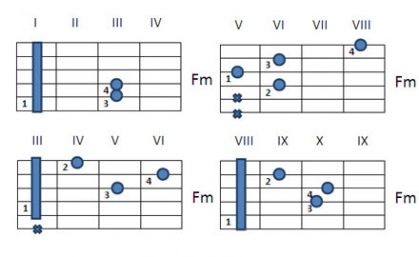 Понять как играть аккорд Fm (минорный аккорд построенное от ноты Фа) не так легко: первым делом нужно запомнить как ставятся рука и пальцы и зажимается барре.
Посмотрим, как это делается в первой позиции (смотрите на картинке слева вверху).
Новичку играть на гитаре аккорд Фа минор в этой позиции будет непросто. Задействованы 3 пальца, указательным зажимается барре. Зажимается первый лад и четвертая и пятая струна на третьем ладу. Это одно из самых несложных минорных трезвучий с использованием барре.
Когда у вас получится ловко ставить руки на грифе в первую позицию, приступайте к остальным вариантам.
Материалы по теме

Какую гитару купить ребенку
Какую гитару купить ребенку для обучения от 4 до 12 лет? Ответим на этот вопрос в нашей новой статье!

Как играть на электрогитаре
Наверняка у многих из нас замирало сердце и застывало дыхание от мелодичного звучания этого невероятного инструмента. Электрогитара — достойный музыкальный инструмент, чтобы научиться на нем музицировать. Давайте узнаем как!
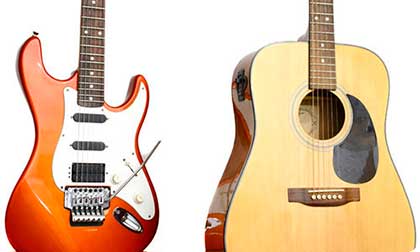
Какую гитару выбрать
Акустическая гитара или электрогитара? Узнайте из этой статьи в чем их отличия и какая подойдет именно вам!
Fm Chord on the Guitar (F Minor) – 10 Ways to Play (and Some Tips/Theory)
The F minor chord is a relatively popular guitar chord. The root 6 bar chord version of F minor is played on the 1st fret, so the Fm chord is often used as a kind of default chord for practising the minor bar chord.
The Fm chord does not contain any notes that can be played on the open strings of the guitar, so there is no way to play the Fm chord as an open chord.
Some Quick Fm Chord Theory
- The F minor chord contains the notes F, Ab and C.
- The F minor chord is produced by playing the 1st (root), flat 3rd and 5th notes of the F Major scale.
- The F minor chord (just like all minor chords) contains the following intervals (from the root note): minor 3rd, Major 3rd, Perfect 4th (back to the root note).
- F minor is the relative minor of Ab Major.
- Fm is the first chord in the key of F minor. The seven chords in the key of F minor are: Fm, G diminished, Ab+, Bbm, C, Db, E diminished
10 Ways To Play The F Minor Chord
If you’ve come to this page just to view some chord diagrams for Fm, here they are.

Standard Fm Chord Shape
The most common way to play the F minor chord is as a root-6 minor barre chord, starting in the first fret. This is usually the Fm shape that most guitarists default to, but it can actually be a tricky chord to play, because it requires barring the first fret, which is the widest fret on the guitar.

Easy Fm Chord Shape
The ‘easy’ or ‘mini’ version of the F minor chord is achieved by playing the first three strings of the guitar, all in the first fret. This can be used as an easy alternative to the more difficult barre chord shape (pictured above).

How to Play the Fm Chord (Step by Step)
- Place your first finger on the first fret of the sixth string and barre all six strings.
- Place your third finger on the third fret of the fifth string.
- Place your fourth finger on the third fret of the fourth string.
- Strum all six strings.
The instructions above are step by step instructions for playing the common F minor chord shape. Forming the chord through step by step instructions is a great way of ensuring that you are interpreting the chord diagram correctly.
F Minor Barre Chord Shapes
The Fm chord can be played as a barre chord by playing a root 6 barre chord shape and starting on the 1st fret or by playing a root 5 barre chord Major shape and starting on the 8th fret:

F Minor Triads
Playing triads is a great way of exploring the minor chord and the guitar fretboard more generally. By arranging the notes of the chord systematically using permutations (root position, first inversion, second inversion), interesting and unique shapes and voicings are created. The three different voicings for the F minor triad are:
- F minor Triad (Root Position) – F, Ab, C
- F minor Triad (1st Inversion) – Ab, C, F
- F minor Triad (2nd Inversion) – C, F, Ab
By playing these triads on two different groups of three strings, we can produce six different shapes.

Which Keys Have The Fm chord in Them?
The Fm chord can be found in the following keys:
- The key of F minor (Fm, Gdim, Ab, Bbm, Cm, D, Eb)
- The key of Bb minor (Bbm, Cdim, Db, Ebm, Fm, Gb, Ab)
- The key of C minor (Cm, Ddim, Eb, Fm, Gm, Ab, Bb)
- The key of Ab Major (Ab, Bbm, Cm, Db, Eb, Fm, Gdim)
- The key of Db Major (Db, Ebm, Fm, Gb, Ab, Bbm, Cdim)
- The key of Eb Major (Eb, Fm, Gm, Ab, Bb, Cm, Ddim)
Alternative But Useful Fm Chord Shapes
The following shapes are alternative ways of playing the F minor chord shape. They’re not the most common Fm shapes, but used enough to include here as interesting alternatives.

Fm Chord Substitutions
Most F minor chords with extensions can be used as a substitute for the F minor chord. For example, Fm9, Fm11 and Fm6 can often be used to add colour and emotion to the F minor chord.
The Fm7 chord is quite often used interchangeably with the Fm chord.
For more interesting substitutions, playing variations of the F chord (which is the relative Major of F minor), such as Ab6, Ab69, Abmaj9 etc. can be used effectively as a substitute for the F minor chord.
Which Scales Can Be Played Over the F Minor Chord?
The most common and effective scales that can be used to solo/improvise over the F minor chord, or to create melodies for the purposes of song writing are:
Fm Chord Lesson: Easy Shapes for Beginner Guitarists
The Fm chord doesn’t appear too often but it’s one you need to know. I always tell my students “you need to know all of the major and minor chords if you want to call yourself a guitarist” so let’s get stuck in! ��
In this free Fm chord lesson you will learn:
- How to play a standard F minor chord correctly
- An easy 1-finger version of the Fm chord that’s ideal for beginners
- Two great alternative versions for of the Fm chord
Over 250,000 guitar-learners get our world-class guitar tips & tutorials sent straight to their inbox: Click here to join them
The standard way to play the Fm chord
In its full form the F minor chord looks like this:
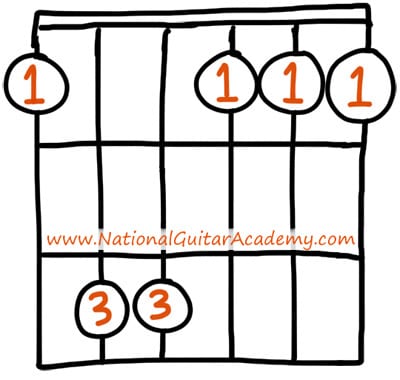
(If you don’t understand the above image please read our article «How To Read Guitar Chordboxes In 60 Seconds«. It will make everything clear!)
As you can see, the Fm chord is too difficult for beginner guitarists to play so we need to look at some easier options.
All of my students struggle with the F minor chord when they first encounter it, so don’t worry if you find it tough, that’s normal!
An easier way to play the Fm chord
This first version of the Fm chord is a simple reduction of the chord above:
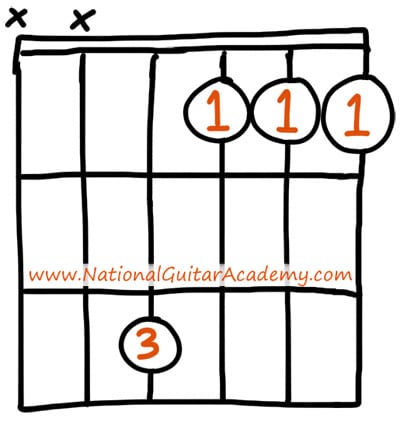
This Fm chord is easier to play than a standard one, but you will still find it quite tough to play.
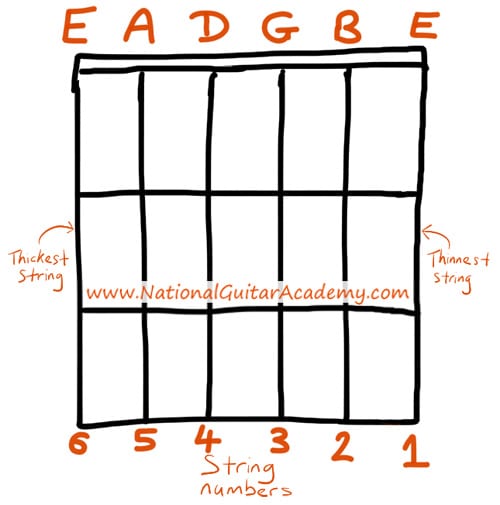
Beware the detail here – you must avoid playing strings 5 & 6 for this to sound correct. Here’s a quick refresher on string numbers:
Learn 12 EASY beginner chords with our popular guide
✅ Stop struggling. Start making music.
✅ Learn beginner-friendly versions of every chord .
This is our most popular guide and it will improve your chord ability quickly! ��
Get your own personalised guitar-learning plan ��
Get a custom guitar-learning plan here: Click here for GuitarMetrics™
World-Class Guitar Courses ��
Learn from the world’s best guitar educators: Click here for our guitar courses
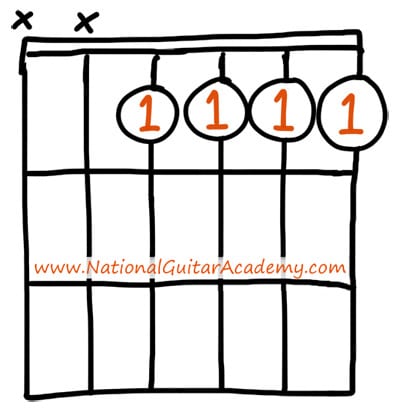
A super-simple Fm chord
I love this way of playing the Fm chord. It’s well suited to people who are very early on in their guitar journey:
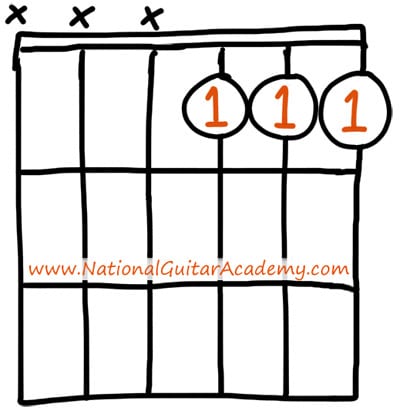
This is a much simpler version of the Fm chord (it’s a pure minor triad). It doesn’t sound as full as the two earlier versions of Fm chord we looked at, but it will do the job until your skill improves to a point where you can play one of the other harder (and fuller-sounding) versions of the F minor chord.
Note that with this version you can simply use 1 finger to press all 3 strings down. Take care and ensure you don’t play strings 1-3 as that will ruin the chord.

The Best Easy Versions Of This Chord
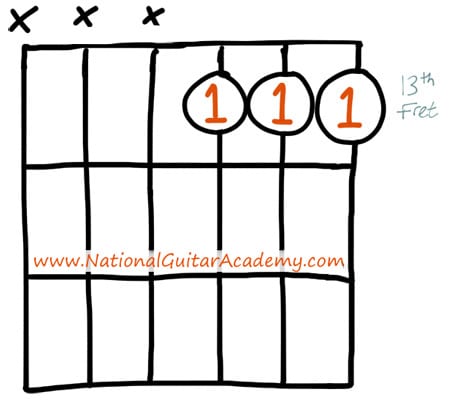
A simple and funky Fm chord
You can slide the above shape up to the higher octave. This sounds great in jazz/funk styles. Get your hands moving up to the 13th fret and give it a try! ��
Another cool F minor chord alternative
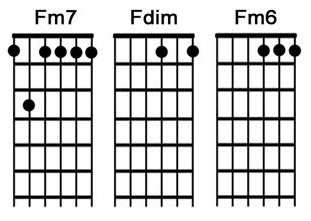
Technically this last version isn’t an Fm chord, it’s actually Fm7, but it’s a good alternative all the same. Give it a try:
Can you hear the difference compared to the other versions of the Fm chord? It’s now up to you to decide which one suits your current level of ability and works best for the piece of music you are playing. This video does a good job of highlighting different ways to play the Fm chord.
Here are some other cool-sounding Fm chords
.
Thanks for reading
I hope you enjoyed this free lesson, have fun playing these different types of Fm chords! ��
What Type of Guitarist Are You?
Take our 60-second quiz & get your results: Take The Quiz
Join the world’s best online guitar school ��
- Get your own personalised guitar learning plan (customised just for YOU).
- World-class online guitar courses. Learn at your own pace.
- Community Campus & Learning Forum — A friendly community! Connect with our team & students. ��
- Beginner Song library with chordsheets, tabs and tips. (Songs suitable for all levels!)
- Regular live streams, seminars and Q&A sessions — Learn from world-class guitar educators. Get all your questions answered!
Cool Guitar T-shirts ��
Look cooler! Check out our merch: Click here to see our merch store
Want free guitar tips and video lessons delivered to your inbox?
Join over 250,000 other guitar learners and subscribe to our guitar-tips-by-email service. (It’s free.)
We’ll send you a series of lessons that will move you to the next level of your guitar journey.
Learn how everything fits together quickly, easily and effectively. We share ninja tips (for instant fun!) but also timeless fundamentals that will deepen your understanding.
До-мажор.ru — тексты песен с аккордами для гитары

Аппликатуры аккорда Fm (Фа — минор) для шестиструнной гитары
Ниже изображены аппликатуры аккорда Fm в различных позициях, а также даны необходимые пояснения и рекомендации.


Обратите внимание на следующее
Лады пронумерованы сверху. Ноты, соответствующие звучанию открытых струн (строй гитары), указаны слева. Нижняя струна на схеме — это басовая (толстая) E (Ми), а вверху на схеме изображена струна E, соответствующая нижней (тонкой) струне гитары. Некоторым это может показаться нелогичным, но на самом деле всё выглядит так, как если бы вы смотрели на гитару сверху вниз держа её в руках как при игре, но немного повернув к себе верхней декой.
Черный кружок с цифрой обозначает где нужно зажать струну и каким пальцем (1 — указательный, 4 — мизинец). Прием, когда две и более струны прижимаются одним пальцем, называется баррэ. Незакрашенные (белые) кружки обозначают дополнительные варианты прижатия струн, которые не изменяют аккорд. Красным крестиком обозначены струны, которые необходимо глушить, но он (крестик) не обозначает место глушения, вы можете делать это так как вам удобнее или просто не извлекать звук из этих струн. Также встречаются варианты с крестиком и белым кружком на одной струне, это означает, что если вы не прижимаете струну как показано на рисунке, то ее необходимо глушить.
Учтите, что многие аккорды, которые берутся в первых трех позициях (1-3 лад) без барре (в том числе и так называемые блатные), получаются из аппликатур, строящихся от 12 лада, так что если здесь отсутствует нужная схема в позициях 1-3, вы легко получите ее из 12-й, для этого просто перенесите аппликатуру так, что бы роль указательного пальца левой руки играл верхний порожек. И вообще, зная аппликатуру, например, любого мажорного аккорда, можно построить и все остальные мажорные аккорды просто перемещая аппликатуру по грифу на нужное количество полутонов (ладов) вверх или вниз, тоже самое и со всеми остальными видами аккордов (миноры, септаккорды и т.д.), правда, открытые струны в большинстве случаев нужно глушить. Перемещением аппликатур по грифу также объясняется и тот факт, что в каких-то позициях струны, обозначенные крестиком, можно не глушить, так как в этих позициях открытая струна как раз попадает в одну из нот аккорда. Что касается аккордов, строящихся на первых трех ладах, то в таких аппликатурах нужно глушить только те струны, которые не должны звучать, когда вы строите тот же аккорд от 12-го лада.
Если кто-то испытывает затруднения, здесь более подробно рассмотрены строй и настройка гитары, а также соответствие между латинской (C, D, E . ) и слоговой (До, Ре, Ми . ) системами обозначения нот.