Таблица перевода классов вязкости, используемых различными организациями

Таблица может использоваться только для перевода вязкости, а не для определения количества масла.
Как пользоваться таблицей
Например, производитель оборудования требует применения масла марки SAE 30. Находите по горизонтали соответствующую марку ISO — в нашем случае это ISO 100.
— Эквивалентные единицы вязкости находятся на одной горизонтали.
— Предназначена для сезонных масел с кинематической вязкостью при 40 о С, равной 100 мм 2 /с (сСт).
— Эквиваленты подобраны только для вязкости при 40 о С.
— Предельные значения приблизительные, для более точных данных см. спецификации.
Что такое ISO
Международная организация по стандартизации (International Organization for Standardization, ISO) — международная организация, занимающаяся выпуском стандартов.
Классификация ISO для жидких индустриальных смазочных материалов была введена в феврале 1975 г. как стандарт ISO 3448 и с тех пор ею повсеместно пользуются во многих странах мира. В соответствии с этим стандартом промышленные масла подразделяются на 18 классов вязкости от 2 до 1500 мм 2 /с при 40 о С и, таким образом, данная классификация охватывает весь спектр масел: от легких шпиндельных до тяжелых цилиндровых. Каждый класс вязкости обозначается целым числом, а пределы каждого класса составляют ±10% от этого значения. Иногда класс вязкости промышленных масел обозначают без указания ISO, например, VG 10, где VG (viscosity grade — марка вязкости) показывает, что это классификация по ISO (как для моторных — SAE), а цифра — значение класса вязкости. Следует помнить, что эта классификация не дает оценку качества промышленного масла, а позволяет получить информацию только о кинематической вязкости и только при температуре 40оС. Вязкость при других температурах зависит от температурно-вязкостных характеристик масел и определяется дополнительно.
ISO VG Vs. SAE: What Are The Differences?
In many ways, you can determine the lubricant’s viscosity grades like SAE, ISO, AGMA, SUS Secovis, and absolute viscosity. SAE grades stand for the Society of automotive engineers for gear oils and automotive engines.
To fulfill the lack of a universal grading system among manufacturers, ISO created a standard in 1975 with other groups. And the standard is ISO VG (the International Standards Organization Viscosity Grade). But the question is ISO VG Vs. SAE: what’s the difference? 
Please enable JavaScript
Although there is no significant difference between SAE and ISO VG, they come with different purposes. Let’s learn more information about this topic:
Table of Contents
What Is ISO VG?
ISO VG stands for “International Standards Organization Viscosity Grade” and is reported as a number from 2 to 1500. This number is crucial because the viscosity of a lubricant is the most essential factor during choosing the right oil.
As the equipment is manufactured worldwide, you should follow the standard when determining the proper lubricant. ISO VG is reported in cSt and measured by kinematic viscosity, which measures fluid flow. The typical test instrument is the capillary tube viscometer test. This test is performed by putting oil in a glass capillary U-tube and handling it at 40°C (104°F). If the oil is thick, it is a high ISO VG.
What Is SAE?
Oil viscosity is impacted by temperature. SAE, short for the Society of Automotive Engineers, is responsible for establishing an oil viscosity classification system.
The SAE is a United States organization founded in 1905 by Andrew Ricker and Henry Ford. Now known as SAE International, the group includes engineers from the petroleum, trucking, automotive engineering, and aerospace industries.
An SAE oil is an engine oil that meets the SAE International of Automotive Engineers standards. To classify oils, their viscosity is estimated as cold at different temperatures below zero and then hot at 100ºC. Using this base measurement, oils are divided into monograde or multigrade.
Difference Between ISO VG Vs. SAE
There is no notable difference between ISO and SAE. Both are given test standards for reliable comparison of published filter ratings between manufacturers.
SAE and ISO have different standards. Actually, the ISO oil grades are identified by VG or viscosity grade. ISO grades are approximate equivalents to SAE grades.
Accordingly, ISO, ASTM, DIN, and others have developed a standard viscosity classification. The result is ISO VG – the International Standards Organization viscosity grade. This classification is mainly applicable for use with industrial lubrication. Each grade viscosity is ± 10 % from the midpoint.
In contrast, by SAE lubricant oils, viscosity is also determined. Multigrade and monograde is the classification of oils. Multigrade oils must meet two viscosity characteristics; their viscosity grade consists of two numbers, such as 10W-40. 10W indicates low-temperature viscosity 40 indicates high-temperature viscosity.
ISO VG Vs. SAE Calculator
Adequately, ISO, SAE, and AGMA have developed competing standards for determining oil viscosity ranges. Among them, most standards mean the same thing. ISO VG calculates oils at 40ºC; a given range is +/-10% of their stated value. So an ISO VG 100 has a viscosity between 90 and 100 cSt at 40ºC.
On the contrary, SAE measures oil at 100ºC. According to its VI, the oil is diluted, and the chart is calculated with a specific viscosity index (VI 95 default).
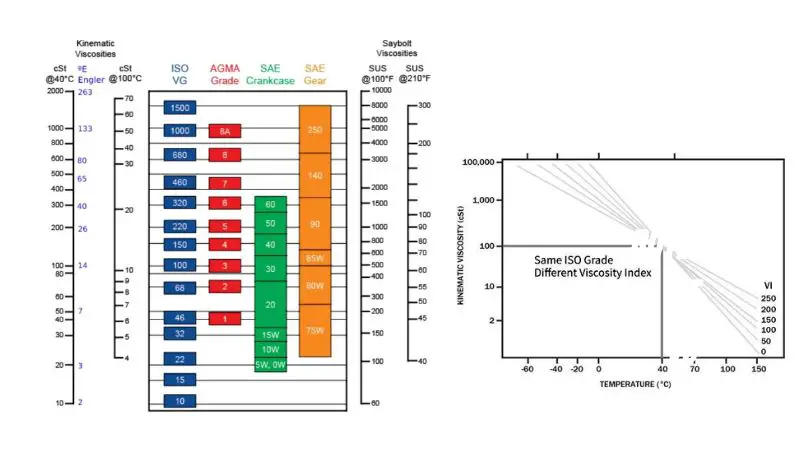
Photo Courtesy: oilviscositychart.com
This chart shows oil has a viscosity index of 95. For most oil, it’s a good approximation.
This calculator follows ASTM D2270 – 10 Standard Practice for Viscosity Index Calculations from Kinematic Viscosity at 40ºC and 100ºC.
Additionally, the calculator uses centistokes (cSt), which is equivalent to mm^2/s. If you have a viscosity in centipoise, divide the centipoise value by the density of the oil to get centistokes.
You can see ISO VG VS SAE Chart and the relation between the in the video
ISO VG 68 Oil Equivalent
AW 68 hydraulic fluids have an ISO VG 68. Hence, it is the liquid thickness tested at 40°C. ISO VG 68 is a heavier hydraulic fluid that flows equivalent to an SAE 20-weight lubricant. Thus, this can be useful in systems with leakage at high temperatures. Nevertheless, there are also many alternatives to ISO VG 68 oil that you can use as an equivalent. The products are:
- Fuchs Renolin B 20 VG 68
- Gulf Harmony Hydraulic Oil AW 68
- BlueSky PureBlu Hydraulic Oil 68
- Chevron Rando HD 68
- Mobil DTE 26 Ultra
- Shell Tellus S2 MX 68
ISO VG 220 Equivalent
As an equivalent of ISO VG 220, you can use AGMA 5 oil. Besides this, you also can use AGMA 6, ISO VG 320, AGMA 7 to ISO VG 460, and more. Though they can’t perform as well as ISO VG 220 products, you can use them in an emergency.
ISO to SAE Oil Chart
Viscosities can be horizontally related to viscosity based on 96 VI single-grade oils.
- ISO specified at 40°C
- AGMA specified at 40°C
- SAE 75w, 80w, 85, 5w, and 10w
- Specified at low temperatures.
Equivalent viscosities are shown for 100° and 210°F.
Final Word:
On the other hand, ISO and SAE are standard specifications that determine oil weight. Ultimately, this standard ensures that one 30-weight oil brand has the same viscosity as another.
Furthermore, ISO oil grades are identified by viscosity grade or VG. ISO grades are approximate equivalents to SAE grades based on viscosity measurements at various temperatures. However, here we have given the best information about ISO VG Vs. SAE. After reading this article, you will understand the grading system.
Emon is Lubricants specialist who studied on Petroleum Engineering in UAE. He have more than 10 years experience on different kinds of lubrication including automobile troubleshooting.
READ MORE
You should heat your oil to a specific temperature to properly coat all your engine moving parts. If the oil is too cold or hot, your engine experiences performance problems. Oil temperature also has.
Like the human body, the blood circulating in the body must be healthy to function correctly. The same is true for machines; lubricant health should be in good condition to acquire higher machine.
About Us
We are all kinds of Engine Oil & Lubricants experts, who can suggest you select the right oil for your Engine; whatever the engine is an automobile or any industrial equipment. Our Oil experts & Mechanical engineers are always ready to provide solutions for all engine oil-related problems.
DISCLAIMER
All Information is provided by Takeuroil.com while trying to keep the information up to-date and accurate. Takeuroil is a participant of some programs which may be designed to provide a means for website owners to earn advertising fees or commission by advertising and linking.
Конверсия трансмиссионного масла SAE в ISO
Общество инженеров автомобильной промышленности (SAE) и Международная организация по стандартизации (ISO) имеют разные стандарты для трансмиссионного масла. Марки масла ISO определяются по степени вязкости или VG. Оценки SAE, эквивалентные маркам ISO, являются приблизительными, поскольку они основаны на измерениях вязкости при различных температурах. Марки трансмиссионных масел также могут изменяться со временем из-за изменений вязкости, возникающих при использовании. Трансмиссионное масло смазывает шестерни в автомобилях и коробках передач промышленных двигателей.
Шаг 1
Ищите признаки того, что масло универсальное. См. Марку SAE, указанную на этикетке контейнера. Марки SAE, обозначенные цифрой, а затем буквой, являются универсальными маслами. SAE 5W-30 и SAE 10W-30 – универсальные масла. Зубчатая передача SAE класса 80W-90 соответствует стандарту ISO 100.
Шаг 2
Определите, предназначено ли масло для использования в картерах двигателя или для смазки зубчатых колес. ISO VG класс 22 эквивалентен SAE картера 5W. ISO 86 VG соответствует классу масла SAE картера 20 Вт. Класс ISO VG 100 соответствует классу 30 SAE для картера двигателя. Максимальный класс масла SAE – 60, что соответствует стандарту ISO VG 320. Класс 46 ISO соответствует классу смазки редуктора SAE 75 Вт. Класс вязкости ISO 68 соответствует SAE 20. Класс 220 ISO соответствует смазке для редуктора SAE 90. Класс 460 ISO соответствует классу смазки для SAE 460.
Шаг 3
Измерьте вязкость с помощью вискозиметра, если условия далеки от первоначальных условий испытаний, на которых определены оценки SAE или ISO. [SAE oil] (https://itstillruns.com/sae-oil-6900460.html) оценки определяются вязкостью масла при 100 градусах Цельсия. Вы можете проверить очень горячие и холодные температуры с помощью термометра. Экстремальные температуры могут привести к очень различной вязкости, чем стандартная для данного сорта. Марки трансмиссионного масла также могут меняться со временем из-за химических изменений, возникающих при использовании. Непосредственно измерьте вязкость, чтобы определить правильную оценку ISO в любом из этих случаев.
Преобразуйте измеренную вязкость в вязкость ISO, чтобы определить правильную оценку. SAE измерения вязкости масла даны в сантипуазах, сокращенно до сП. Сантипуаз равен 1 миллиПаскаль в секунду или мПа * с. Уровни вязкости по ISO измеряются в сантистоксах, сокращенно как cST и измеряются в миллиметрах в секунду. К счастью, Centipoise и Centistokes имеют соотношение один к одному. Если вязкость SAE измеряется в паскаль-секундах, разделите вязкость SAE на 1000, чтобы получить значение в сантисоксах.