The difference between FORCE and POWER

Strength is all about producing force.
Power is all about producing…well, power.
Perhaps we should rename “strength training” to “force training”?
Here’s the simplest and most practical way to tell the difference.
If it is possible to do slowly, it is a strength exercise.
If it is only possible to do quickly, it is a power exercise.
Can you deadlift slowly?
Yes, you can. It sucks…but you can do it.
Can you power clean slowly?
No, no you cannot. If you try, it becomes some kind of horrifying-looking semi-explosive reverse curl. You need to move quickly, explosively, aggressively, POWERFULLY…or else you just miss the lift.
Can you squat slowly?
Sure. Again, this takes more concentration and effort than squatting at a comfortable pace, but it’s certainly possible.
Can you jump slowly?
No. Try it. And please film it. It’s just not possible. You won’t even leave the ground. Every time you jump, you should be trying to jump as high…
…or as far as possible. You want to do it as FAST as you can as well, because it’s a power exercise.
Can you press slowly?
Definitely. If you are lifting maximal weights, the lift will take 4–7 seconds to complete as you work through the sticking point.
Can you push press slowly?
Sort of? You need to generate momentum with the legs to get the bar moving. The top part of the lift might be slow as you lock it out, but the bottom half is always very fast. This puts it in the unusual category of being both a strength and power movement.
Can you jerk slowly? (get your mind out of the gutter!)
Nope. A jerk always happens extremely quickly. You either make, or you miss it. There is no grinding out a jerk. Jerking requires a lot of focus and technique. Get distracted for even a moment…and there is just no way you’ll have a successful jerk.
Can you bench press slowly?
You sure can. If you are lifting max weights, it’ll be slow even if you want it to go fast.
Can you throw slowly?
No. Whether it’s a medicine ball or a baseball, you cannot throw anything slowly. Try it with an object nearby if you don’t believe me. You might do the first part of the motion slowly, but I guarantee you’ll cheat and do the last part quickly, because otherwise the object is lacking the velocity needed to actually GO anywhere.
That last part is key-velocity, or how FAST the movement is being completed.
Force=Mass*Acceleration
How do you maximize force? Heavy weights, accelerated as quickly as possible. You still want to TRY move quickly when “strength training” as acceleration is a component.
Power=Force*velocity
How do you maximize power? By focusing on speed. Because of the added velocity component, how fast you move is important. A true 1 rep max on squat/bench/deadlift is terrible for power production because it happens so slowly.
This next part is a bit technical, so I’ll try to explain it as best I can!
Force is the blue line. As you can see, it tends to fall, supporting the idea that heavy weights require higher forces to move.
Power is the red line. Heavy weights, on the left, are high force but so low velocity that power is low. As you move right, the weights are lighter (so force is lower), but the velocity is increasing a lot, so power is going up.
Eventually, you get to the teal (or indigo? what a gross color…of all the colors they had to pick that one?) line where power is maximized—the best outcome of multiplying force and velocity.
From there, velocity continues to increase, but force is now falling at a rate that more than cancels that out, leading overall power to decrease.
If you look at the red curve, there are quite a few force/velocity inputs that result in quite a high power-as long as you are somewhat near optimal, you’ll be getting a good workout. So, what is optimal?
So, what percentage should you train to maximize power?
0% to 80%. That’s a pretty big range, so I’ll explain.
Jumps are usually 0% (just bodyweight). You can’t jump with less than your bodyweight unless you have a jetpack or something.
Throws are
The powerlifts (maybe they should rename powerlifting to “forcelifting”?) are as follows:
Bench press 40–60%, squat 50–70%, deadlift 50–60%.
Olympic lifting is usually around 80%.
Lifting a moderate weight quickly or a light weight very quickly tends to even out-that red curve is pretty generous when it comes to programming.
You can squat, bench press and deadlift for strength, or you can lighten the load and do it for power. Up to you.
But jumps, throws and Olympic lifting cannot be done for strength. They are exclusively power exercises.
Force vs. Power

The concepts of force and power seem to convey similar meanings and are often confused for each other. But in physics, they are not interchangeable. Force is the fundamental result of an interaction between two objects, while power is an expression of energy consumed over time (work), of which force is an element. Force and power can both be described and measured, but a force is an actual physical phenomenon, and power in itself is not.
Comparison chart
 |
Force | Power |
|---|---|---|
| Definition | A push or a pull resulting from an interaction between objects. | Power is the rate at which work is done, or energy is transmitted. |
| Unit | newton | watt = joules/second |
| Symbol | F | P |
| Named After | Isaac Newton | James Watt |
| Derivations from other quantities | F = m a (force = mass multiplied by acceleration) | P = w/t (power = work divided by time) |
| Relation to “Work” | Force applied over a distance creates work. | Rate at which work is performed. |
| Everyday Example | Gravity, friction, magnetism. | Horsepower (1 horsepower = 750 Watts). |
Basic Concept
A force can only occur when objects are interacting. Whenever objects interact, they push or pull one another, whether through direct contact or at-a-distance contact. Examples of direct contact forces include the friction of car tires on a road, or the air resistance on a moving car. At-a-distance interaction occurs through forces like gravity and magnetism. Force is a fundamental expression of physical occurrences, as are time and distance.
Power is defined as the amount of energy consumed per unit of time. Another way to put this is: the rate at which “work” is done. Work occurs when there is force causing movement of an object. For example, a person pressing against a brick wall is consuming energy, but no work is being done and no power created because the wall does not move. But if a person pushes on a table and moves it, then there is work. Power expresses how quickly that work is done. So, force is one element of the power equation, along with other basic elements like distance and time.
Formulae
Force is calculated as a product of mass and gravitational acceleration, and is usually denoted as

Force can be the result of direct or indirect interaction between two bodies. Mathematically, the force can be defined as the product of the mass of the body and acceleration produced in the body due to the action of force on the body, i.e.
The SI unit of force is Newton (N). The force applied on a body is said to be 1 N if the body has a mass equal to 1 kg, and the body has an acceleration of 1 m/s2 due to the action of the force. Force is a vector quantity, therefore, it has magnitude as well as direction.
Based on the application, force may be classified into the following two types namely,
- Contact Force – When forces act on a body by making direct contact or contact through a medium with the body is referred to as a direct force. For example, frictional force, air drag, mechanical forces, etc.
- Non-Contact Force – Non-contact force is one that acts without making a direct connection with the object, i.e. act through space. For example, gravitational force, magnetic force, electric force, etc.
What is Power?
Power is defined as the rate of doing work. In other words, the amount of energy expended to perform work per unit of time is known as power.
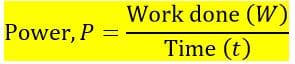
Therefore, power can be mathematically expressed as,
The SI unit of power is Watt. When 1 joule of work is done in 1 second, then power is said to be of 1 watt.
Depending on the type of system, power can be of two types namely, electrical power (examples average power, instantaneous power, reactive power, apparent power, etc.), and mechanical power (examples hydraulic power, wind power, etc.)
After getting the basic insights about force and power, let us now discuss the differences between force and power.
Differences between Force and Power
The important differences between force and power according to different factors are listed in the following table:
Conclusion
Thus, this is all about the differences between force and power. From the above comparison, we may conclude that force and power are two absolutely different physical quantities. The one most significant difference that can be stated from the above comparison is that force is responsible for changing the state of a body, whereas power gives information about the rate at which work is being done.